Five Days of Eating Like Britain: The Salt Trail Hiding in Your Fry-Up, Meal Deal and Sunday Roast
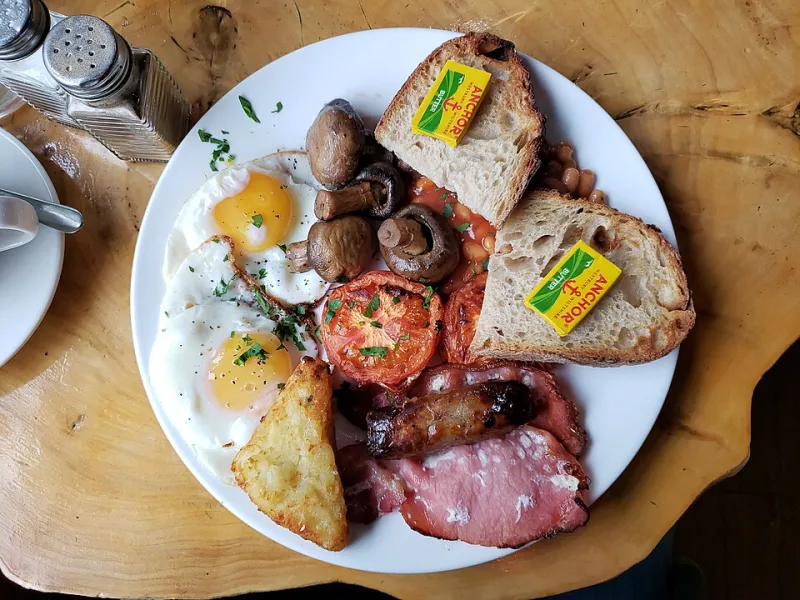
Photo: Andy Li, CC0, via Wikimedia Commons
The experiment: eating like most of Britain
No juice cleanses. No imported superfood bowls. Just five days of the food that actually fills British plates — the fry-up, the meal deal, the ready meal, the takeaway, the Sunday roast. We wanted to know what a completely ordinary week of UK eating looks like when you break it down into the numbers that matter for blood pressure and blood sugar.
What we found wasn't shocking because of any single meal. It was the accumulation — the quiet drip-feed of salt and refined carbohydrate that never feels like a decision because it's baked into the food itself.
Day one: the full English
Two sausages, two bacon rashers, a fried egg, beans, toast and a mug of tea with two sugars. A beloved institution — and roughly 6-7g of salt in one sitting, depending on the butcher. That's more than the NHS daily recommended maximum of 6g before lunch.
The sausages and bacon do most of the damage. Cured meats are among the saltiest items in the British trolley, and the beans, despite being a decent fibre source, add another hidden gram or two. The white toast spikes blood sugar quickly on top of it all.
Day two: the meal deal and desk lunch
A supermarket meal deal feels harmless — it's £3.99, it's efficient, it's culture. But a typical combination (white bread sandwich, crisps, fizzy drink) delivers around 3g of salt and, in the sugary-drink version, up to 35g of sugar in one go.
The real issue is repetition. Four of these a week is 12g of salt you didn't consciously choose. Nobody's sitting at their desk thinking "I fancy a salt load" — they're thinking "I fancy a tuna sandwich."
Day three: the ready meal
Stick a chicken tikka masala ready meal in the microwave and you're eating convenience at its most calibrated. Salt levels vary wildly — from 1.5g in the better formulations to well over 4g in others. Sauces are the culprit; they need salt, sugar and thickening starches to survive shelf life and reheating.
Pair it with white rice and the refined carb load is substantial. Blood sugar rises fast, then falls faster — which is precisely the pattern that leaves people reaching for biscuits by 9pm.
Day four: the Friday takeaway
A curry and naan from the local is a national ritual. But restaurant sauces are typically generous with both salt and sugar, and a portion of pilau rice is often the equivalent of two servings. A single takeaway meal can carry 8-10g of salt — a day and a half's worth in one evening.
Nobody's suggesting Friday curry is cancelled. But awareness of what's in the sauce changes what you do the rest of the day.
Day five: the Sunday roast
Here's the surprise ending: the home-cooked roast is the healthiest day of the week. Plenty of vegetables, proper protein, and — crucially — control. The salt only creeps in via shop-bought gravy granules, stuffing mixes and salted Yorkshire pudding batter. Make gravy from the roasting juices and the meal transforms.
Why British convenience culture stresses the cardiovascular system
The pattern across the week isn't gluttony — it's outsourcing. Most of the salt in the UK diet comes from processed and prepared foods, not the salt cellar. When 80% of what you eat is made by someone else, your sodium intake is decided by food technologists, not by your palate.
Combine that with refined carbs in nearly every convenience format (white bread, white rice, sugary sauces) and you get the double hit: blood pressure climbing through sodium, and blood sugar lurching through refined carbohydrate. Neither shows up on a single plate. Both show up over a decade.
Practical swaps that don't feel like sacrifice
- Fry-up: grill the bacon, choose lower-salt sausages, swap beans for tomatoes half the time
- Meal deal: pick the water or diet drink — that single change removes up to 35g of sugar
- Ready meal: check the salt per portion; the range between brands is genuinely enormous
- Takeaway: order the rice to share, ask for the curry not to be over-salted, skip the poppadoms
- Roast: homemade gravy, unsalted butter, and you're already there
The bigger picture
One week of ordinary British eating won't define your health. But the same week, repeated for twenty years, quietly shapes your cardiovascular future. The good news is that the roast proved something important: when you control the kitchen, you control the numbers. Even small shifts back towards home-cooked food — plus sensible daily habits around movement and natural nutritional support — give your blood pressure and blood sugar room to settle back where they belong.
You don't have to stop loving British food. You just have to know what's hiding in it.