The Radiator, the Cuff and the Cold Sofa: Getting an Honest Evening Reading
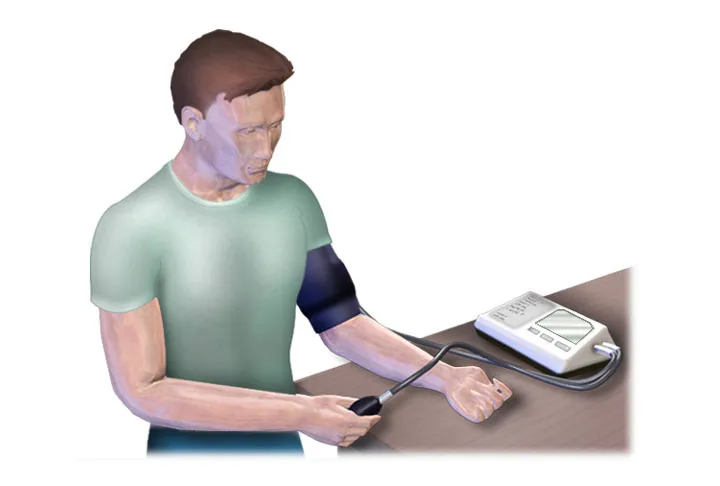
Photo: BruceBlaus, CC BY-SA 4.0, via Wikimedia Commons
There is a particular kind of November evening in the UK that makes home blood pressure readings tricky. The central heating has been on since 4pm. The living room is warm near the radiator and chilly by the window. You are wearing a thick jumper, maybe a fleece, and you have just come in from walking the dog in the dark. You sit down, strap on the cuff, press the button, and get a number that looks higher than usual.
Is that your blood pressure? Partly. But it is also the thermostat, the layers, the cold walk and the fact that you took the reading in a hurry. Home monitors are useful tools, but they are sensitive to circumstances. If you want a reading you can trust, you need to give the cuff a fair chance.
Why the room matters more than you think
Cold makes blood vessels narrow. That is a normal response — your body is trying to keep warm — and it can push blood pressure up temporarily. If you take a reading in a cold room, or straight after coming in from the cold, you may see a number that is higher than your true resting level. The same goes for sitting right next to a hot radiator with the cuff arm draped over the arm of the sofa. Heat and cold both change the picture.
The goal is not to create a laboratory. It is to create a consistent, comfortable setting. A room that is neither freezing nor tropical is a good start. Most people find somewhere around 18–21°C comfortable. If your living room is colder than that, put the heating on for a bit before you measure, or take your reading in a warmer room.
The layered jumper problem
A blood pressure cuff needs to sit on bare skin, or on a very thin sleeve, to work properly. If you roll up a thick jumper and it bunches around your arm, the cuff may not fit correctly or may give an inaccurate reading. If you push your sleeve up and it feels tight, that is also a problem. The cuff should sit snugly but not pinch.
Take the jumper off, or wear a short-sleeved top for your reading. It is a small hassle, but it makes the number more reliable. And if you are measuring at home regularly, it is worth making the process easy: keep the monitor somewhere convenient, and wear something that lets you roll a sleeve up without a fight.
When to measure: the consistency rule
Your blood pressure changes throughout the day. It is usually higher in the morning and lower in the evening, but that pattern is not fixed. What matters for home monitoring is consistency. Try to measure at the same time each day, in the same chair, with the same arm, after the same amount of rest.
For an evening reading, a good routine is:
- Empty your bladder first.
- Avoid caffeine, smoking and exercise for 30 minutes before you measure.
- Sit quietly for five minutes. No phone, no TV debate, no scrolling.
- Sit with your back supported and your feet flat on the floor.
- Rest your arm on a table at about heart level.
- Take two readings, one minute apart, and write down both.
If you have just come in from the cold, give yourself ten minutes to warm up before you measure. If you have just eaten a big meal or had a glass of wine, wait a while. Those things affect the number, and you want a reading that reflects your normal resting state, not your Christmas dinner.
The thermostat tug-of-war
In winter, many homes have a battle between the radiator and the window. One side of the room is hot, the other is draughty. If you always sit in the same spot, you may be measuring under the same conditions each time, which is actually useful. But if you move from the sofa to the kitchen table, or from a warm chair to a cold one, the reading may change for reasons that have nothing to do with your heart.
Try to choose one spot for your readings and stick to it. Keep the temperature as stable as you reasonably can. If the heating comes on with a bang at 5pm and you always measure at 5.05pm, you may be capturing a moment of change. Measure a little later, once the room has settled.
The cuff is not lying, but it is sensitive
Home monitors are not perfect. They can be thrown off by movement, talking, an incorrectly positioned arm, a cuff that is too small or too large, or a battery that is running low. If you get a surprising reading, do not assume the worst. Sit quietly for a few minutes and take another. If the second reading is similar, note it and move on. If it is very different, check your technique and try again later.
Keep a simple log. A notebook or a note on your phone is fine. Write down the date, time, reading and anything unusual — a cold room, a stressful day, a late meal. Over a couple of weeks, you will see a pattern, and that pattern is more useful to your GP than a single dramatic number.
A simple evening routine
Here is a realistic routine for a winter evening:
- Come in, take off your coat and thick jumper.
- Put the heating on if the room is cold, and give it ten minutes.
- Sit in your usual chair and rest for five minutes.
- Take two readings, one minute apart, with your arm supported.
- Write them down.
- If the numbers are higher than usual, resist the urge to take ten more readings. One or two is enough.
When to ask for help
If your readings are consistently high, or if you feel unwell, dizzy, breathless or have chest pain, seek medical advice. Do not rely on a home monitor to diagnose anything. It is a tool for tracking, not a substitute for a GP or pharmacist.
If you are exploring natural support alongside lifestyle changes, Glycoforte is aimed at people who want to support healthy blood pressure and blood sugar as part of a wider routine. It is not a medicine, and it does not replace prescribed treatment. The most useful thing you can do is measure consistently, live sensibly and talk to a healthcare professional if something changes.
The thermostat is not the enemy. It is just one more variable in a season full of them. Give your cuff a fair chance, and the number you get will be a lot more honest.