Why Your Blood Pressure Reads Differently at Breakfast, Lunch and Bedtime

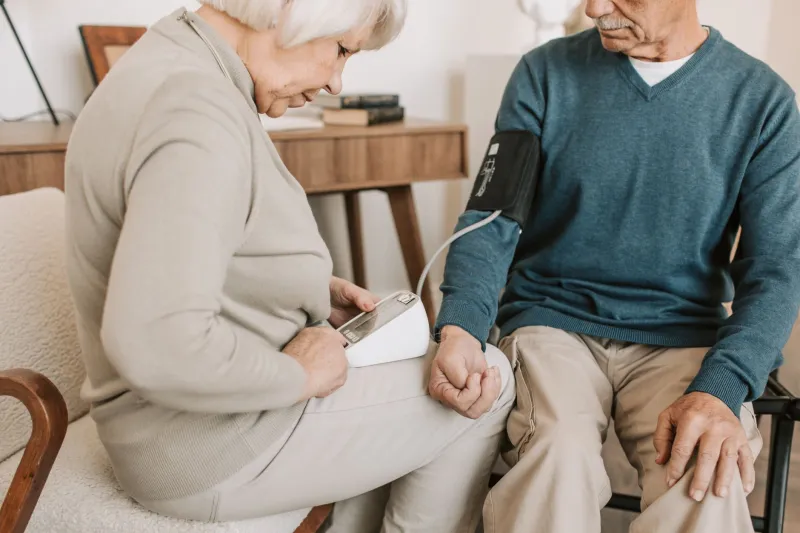
Photo: person measuring blood pressure at home with digital monitor kitchen table, via thumbs.dreamstime.com
You've bought the monitor. You've done the sensible thing. And now you're staring at two numbers that seem to have a personal vendetta against consistency — 128/84 at 7am, 118/76 at lunchtime, 135/88 before bed. Is the machine broken? Are you broken? Neither, almost certainly. You've just met your circadian rhythm, and it's been running this rollercoaster since long before you bought a cuff.
The Daily Ride, Explained
Blood pressure follows a curve that's roughly the opposite of what most people expect:
The morning surge (6am–10am). Your body releases cortisol and adrenaline to get you upright and functional. Blood pressure rises accordingly — often by 10 to 20 points over your overnight low. This is completely normal, though the morning surge is also when cardiovascular events are statistically most likely, which is why GPs take consistently high morning readings seriously.
The midday plateau. Readings typically settle into your lowest territory around midday and early afternoon, especially after lunch and a short walk.
The evening climb. Pressure rises gently through the evening, then should drop by 10–20% as you sleep. If it doesn't drop overnight — a pattern called non-dipping — that's something worth flagging to a doctor.
So a 20-point swing across the day isn't alarming. It's biology. What matters is the pattern, not any single reading.
The Seven-Point Checklist for Honest Readings
Home monitors are brilliant — right up until they're fed bad data. Run this checklist before every test:
- Empty your bladder first. A full bladder can add up to 15 points. Genuinely.
- Sit still for five minutes beforehand. Not scrolling, not chatting — resting. Walking to the kitchen and immediately testing can add 10 points.
- Back supported, feet flat, arm at heart height. Arm dangling by your side inflates the reading. Rest it on a table with a cushion if needed.
- Cuff on bare skin, not over a sleeve. And positioned roughly 2–3cm above your elbow crease, with the tube aligned per the manual.
- Right cuff size. A cuff too small for your arm — a common problem on standard NHS-issue monitors — over-reads, sometimes dramatically.
- No tea, coffee, cigarettes or exercise for 30 minutes prior. All four push readings up temporarily.
- Take two or three readings, a minute apart, and average them. Discard the first if it looks like an outlier.
The Mistakes We See Most
The classic UK self-tester error is the 'GP appointment reading' — testing the moment you get in from a stressful commute, kettle on, coat half off. The second is testing at random times and comparing them directly. A 7am reading versus a 9pm reading tells you nothing unless you compare like with like.
And the third? White coat syndrome in reverse — people so reassured by home testing that they dismiss genuinely elevated numbers as 'just the machine being temperamental.' Machines don't get temperamental. Cuffs do, occasionally. Patterns don't.
When to Stop Guessing and Ask Someone
Book a chat with your GP or pharmacist if:
- Readings are consistently 140/90 or above across a week of properly conducted tests (or 150/90 if you're over 80)
- Your morning readings are consistently much higher than your evening ones
- You get symptoms — headaches, chest discomfort, blurred vision — alongside high numbers
- Your readings swing wildly within the same time of day, which can suggest measurement error or, less commonly, an underlying issue
Build the Habit, Then Build the Support Around It
Monitoring is the foundation, but it's what you do between readings that moves the numbers. The usual suspects matter: less processed salt, more movement, decent sleep, manageable stress. A growing number of UK readers also support their routine with natural supplements — Glycoforte, for instance, is formulated to support healthy blood pressure and blood sugar alongside sensible diet and lifestyle choices.
Keep a simple log — paper or phone — for two weeks. Same times, same conditions. Then you'll have something genuinely useful to show a healthcare professional: not a scary one-off number, but a pattern. And patterns, unlike single readings, can actually be acted upon.
Home monitoring supports but doesn't replace professional care. Always discuss persistent high readings with your GP.