The Sunday Listening Test: What Your Favourite Chair Says About Your Circulation

Photo: Australian National Maritime Museum on The Commons, No restrictions, via Wikimedia Commons
There's a particular kind of silence that settles over a British household at around 4pm on a Sunday. The roast is done, the washing-up is (arguably) done, and the nation's collective population migrates towards its favourite chairs.
But here's a thought worth chewing on: the way you settle into that chair — and what your body does while you're in it — might be quietly telling you something about your circulation.
The Armchair Audit
Start with the chair itself. Is it the sagging old recliner that swallows you whole, knees bent sharply, feet dangling or tucked underneath? It's cosy, yes. But that position — hips folded, calves compressed against the seat edge — isn't doing your blood flow any favours.
Your veins rely on muscle movement in the legs to push blood back up towards the heart. Sit crumpled for three hours of Antiques Roadshow and that system slows right down. Hence the pins and needles when you finally stand, the swollen ankles, the legs that feel heavy rather than refreshed.
Simple Self-Checks From the Sofa
You don't need a clinic to get a rough sense of how your circulation is behaving. Try these during your next Sunday session:
- The sock line check. Take your socks off before you sit down. If the elastic leaves a deep groove that's still visible an hour later, fluid may be pooling in your lower legs — a common sign circulation isn't shifting things along as it should.
- The stand-and-wiggle. When you get up, notice how long it takes for your legs to feel like yours again. A few seconds of stiffness is normal. A minute or more of heaviness, tingling or cold feet is worth paying attention to.
- The temperature test. Rest a hand on each calf. If one feels noticeably cooler or puffier than the other, mention it to your GP — asymmetry is always a clue worth reporting.
- The shoe clue. Shoes feeling tighter by evening, most days? That gradual swelling through the afternoon is a classic sign of sluggish venous return.
None of these are diagnostic tools, of course. But they're useful signals — the kind of everyday evidence your body produces for free, if you're listening.
The Long Drive Home From the In-Laws
Now consider the other great British sitting tradition: the motorway slog. Three hours on the M5 with your knees pressed against the glovebox, a service-station meal deal in your system, and barely a wiggle since junction 14.
Prolonged car travel slows blood flow in the legs just as much as sofa time does — arguably more, given the cramped posture. The advice is unglamorous but effective: stop every hour or so, have a proper walk round the services, flex your ankles while driving, and keep the water intake up rather than relying solely on flat whites.
When the Clues Add Up
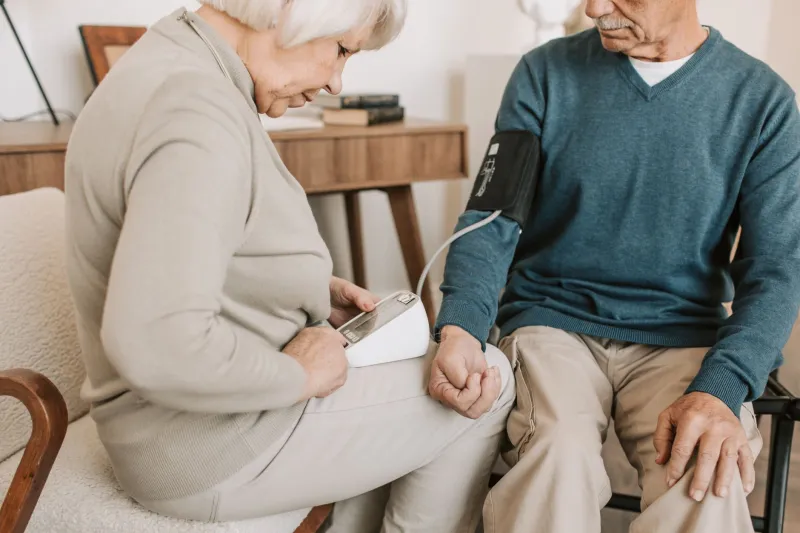
One puffy ankle after a lazy Sunday? Not worth losing sleep over. But if you're regularly noticing heavy legs, cold feet, sock marks, breathlessness on modest exertion, or blood pressure readings creeping up at your pharmacy check, that's your body filing a report.
Circulation, blood pressure and blood sugar are deeply connected. When one drifts, the others often follow — which is why many people in their fifties and sixties are taking a more rounded view of self-care rather than waiting for problems to land on their doormat.
Where a Wider Routine Comes In
Alongside the obvious fundamentals — moving more, watching salt, keeping the weight sensible — a growing number of Britons are adding natural supplements to their routine as a supporting act, not a starring one. Glycoforte is one such option that's caught attention in the UK for its blend of plant-based ingredients aimed at supporting healthy blood pressure and blood sugar levels.
The honest framing matters here: no capsule will outwork a sedentary lifestyle or a salt-heavy diet. But as part of a broader routine — the daily walk, the sensible plate, the regular home readings — a well-chosen natural supplement can feel like sensible insurance rather than wishful thinking.
Give Your Chair a Second Thought
This Sunday, try a small experiment. Set a timer to stand up and wander round the room every 45 minutes. Prop your feet on a footstool so your legs are roughly level with your hips. Do the sock check. Notice what changes.
Your favourite chair isn't the enemy — but a body that never moves doesn't get the chance to tell you how it's really doing. Listen on Sunday. Your arteries will thank you by Monday.